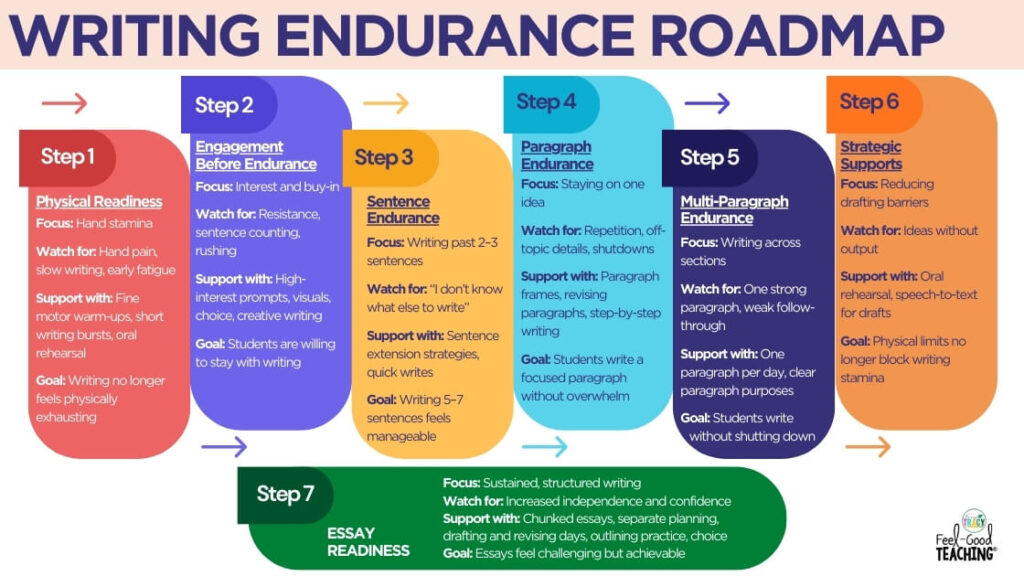
Once students can write more than a few sentences, the next challenge appears quickly: Keeping those sentences focused on one idea in writing paragraphs practice.
This is often where writing falls apart. Students may write several unrelated sentences, repeat themselves, or shut down altogether when asked to write a full paragraph.
So let’s talk about paragraph endurance.
This post focuses on Step 4 of the Writing Endurance Roadmap.
Head back to the introduction if you’ve missed anything in the series so far.
Why Paragraph Writing Feels So Hard
Writing a paragraph requires students to:
- choose a main idea
- stay focused on that idea
- add supporting details
- sequence their thoughts logically
That’s a big cognitive load, especially for students who are still building sentence stamina.
When students don’t have enough paragraph endurance, you may see:
- strong first sentences followed by filler
- off-topic details
- repeated ideas
- emotional shutdowns
This is a sign they need structure and scaffolding, not more pressure.
Paragraph Endurance Is About Focus, Not Length
A paragraph isn’t defined by how many sentences it has. It’s defined by unity.
Students build paragraph endurance when they learn how to:
- stick with one idea
- add meaningful details
- recognize when they’re drifting off-topic
Once focus improves, length usually follows naturally.
Writing Paragraphs Practice: Reduce Overwhelm With Predictable Structure
Paragraph writing becomes more manageable when students know what’s coming next.
Helpful supports include:
- a clear topic sentence
- visual paragraph frames
- checklists that guide, not grade
- sentence starters for support details
Predictable structure frees up mental energy so students can concentrate on content instead of worrying about “doing it right.”
Warm-up Activities to Reduce Overwhelm
If students are freezing up during writing paragraphs practice, it’s helpful to introduce a quick warm-up activity where you give students 1-3 broad topics and have students generate a list of three things they know about the topic or anything related to the topic. See two different examples for the topic “animals” below:
Animals
- Tiger
- Giraffe
- Bear
Animals
- Need water, food & air
- Some can fly
- Some can swim
I like to give 2-3 topics for a warm-up because it doesn’t usually take too long to do and gives students more practice generating ideas for supporting details. Once they have their 2-3 broad topics with lists of three related ideas, I ask students to choose one of those lists to turn into a “bad,” but complete, paragraph. (Revising is saved for a future step.)
Two Notes on Writing Paragraphs Practice:
- If you’re reading this blog series, you’ll notice that the element of choice comes up again and again. It really reduces friction in getting student to write more (and complain less!) when they have a choice.
- Asking for a bad, but complete paragraph gives students permission to focus on the structure only: topic sentence, three supporting sentences, and a closing that ties it together. “Bad” helps get something down on paper that can be improved in a later revision step. This helps your perfectionist students move forward as well as freeing up your reluctant writers relax enough to let ideas flow.
When students turn lists into paragraphs, they might find their lists of three don’t lend themselves well to a solid paragraph, and that’s absolutely OK! In fact, it’s great news if they’re making this realization themselves. Doing this writing paragraphs practice warm up frequently will lead to better lists of three over time. A variation of this could be to make the initial lists longer (e.g. 5-10 items) and have them narrow back to three items to use in their paragraphs. (We’ll discuss this activity and its variations and uses more in depth in the next post.)
Use Revising to Build Paragraph Stamina
One of the most effective ways to build paragraph endurance is through revising instead of drafting.
When students revise pre-written paragraphs, they can:
- analyze what works
- improve clarity and detail
- practice staying on-topic
- build stamina without writing from scratch
This keeps the cognitive demand high while reducing emotional fatigue. They can revise their own paragraphs from the lists of three activity described above, but it’s also incredibly effective to have them revise pre-written paragraphs. This allows them to be more critical (there’s no one to take the criticism personally), and they have all their energy intact for revision because they haven’t had to generate the initial draft themselves.
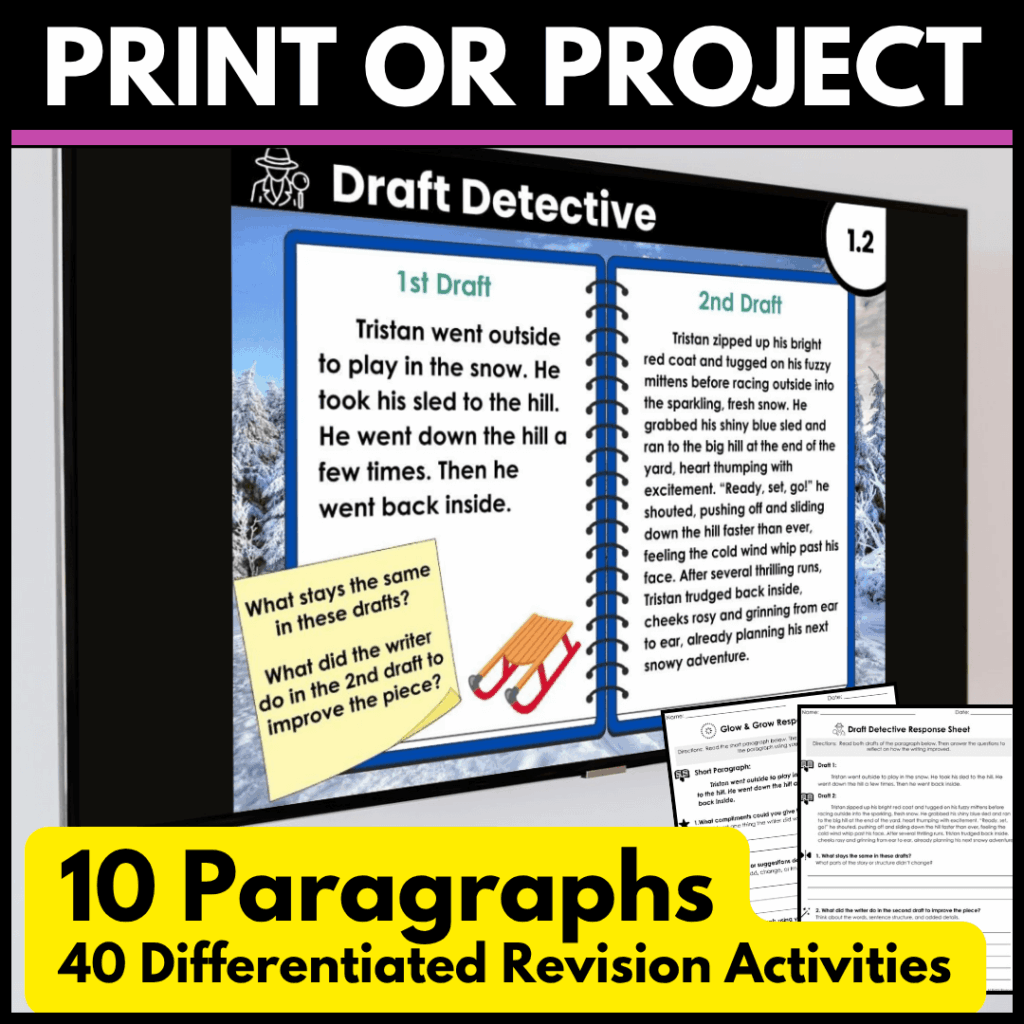
One of my favorite activities for revising paragraphs is the Draft Detective option from the revising paragraphs activity bundle. Students see two paragraph examples side-by-side and compare /contrast. They get examples of how someone revises to improve their writing, and that can make a huge difference for many students!
Writing Paragraphs Practice: Break Paragraph Writing Into Manageable Steps
Instead of asking students to write a full paragraph at once, try chunking the process:
- Write a topic sentence only
- Add one supporting detail
- Add another detail or example
- Revise for clarity and focus
Each step feels achievable, which keeps students engaged longer.
Normalize Stopping Points in Writing Paragraphs Practice
Students don’t need to finish everything in one sitting.
Allowing natural stopping points:
- reduces anxiety
- improves focus
- makes longer writing feel possible
Remember this with your writing paragraphs practice approach: A paragraph written over two short sessions is still a successful paragraph.
What Paragraph Endurance Looks Like Over Time
As students build paragraph stamina, you’ll notice:
- less resistance when writing
- more focused responses
- clearer organization
- increased confidence
Writing a paragraph stops feeling overwhelming and starts feeling doable.
What’s Next
In the next post, we’ll look at what happens after the first paragraph, and why many students shut down when writing needs to continue beyond one focused idea. (Head back to the Writing Endurance series introduction to catch up on past posts.)
That’s where multi-paragraph endurance begins.
Writing endurance grows when students are supported, not rushed.
PIN ME